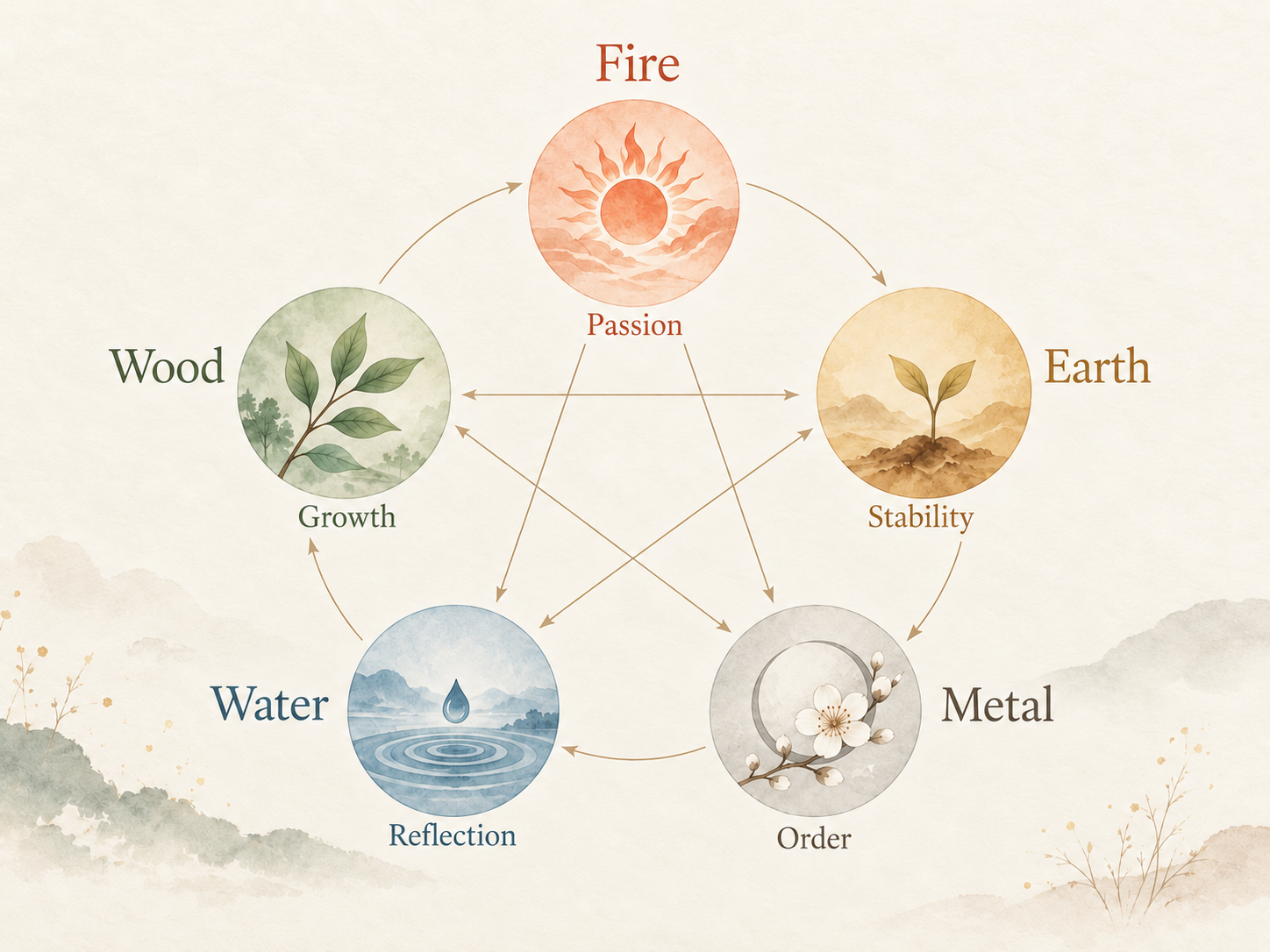
# Which of the Five Elements Reflects Your Personality?
Wood, Fire, Earth, Metal, and Water: Understanding Our Emotional Tendencies Through the Five Elements
We all experience the world differently.
Some of us feel most alive when pursuing new challenges. Others find happiness in meaningful connections and sharing warmth with the people around them. Some prefer stability and familiar routines, while others value clarity, structure, and order. And then there are those who feel most at peace in quiet moments of reflection.
Why do we respond so differently to the same situations?
One interesting way to explore these differences comes from the ancient East Asian philosophy of the Five Elements (Wu Xing, 五行).
The Five Elements—Wood, Fire, Earth, Metal, and Water—represent much more than physical substances. Traditionally, they describe patterns of movement, transformation, function, and relationships within the natural world.
In East Asian medicine, this framework has also been used to understand human physiology, emotional experiences, behavioural tendencies, and the dynamic relationships between body and mind.
So, what might the Five Elements reveal about the different ways we experience and respond to life?
🌿 Wood — The Spirit of Growth and Determination
"I feel most alive when I am moving forward."
Wood represents spring, growth, expansion, and the movement of life towards new possibilities.
People who strongly identify with Wood-like qualities may feel energised by setting goals, embracing challenges, and making progress.
They often enjoy taking initiative, solving problems, and turning ideas into action. When something matters deeply to them, they may show remarkable determination and persistence.
However, this same drive can sometimes make situations involving restriction, delay, or a lack of progress particularly frustrating.
In traditional Five Element theory, Wood is associated with anger (Nu, 怒).
This association does not mean that Wood-oriented individuals are necessarily aggressive or short-tempered. Rather, anger can be understood as a natural emotional response to obstruction, frustration, or the inability to move forward.
What Wood Can Teach Us
The desire to grow is a powerful strength, but not everything unfolds according to our plans or preferred timing.
Sometimes, the ability to bend, adapt, and change direction is just as important as the determination to keep moving forward.
✨ Finding balance: Flexibility, patience, and allowing yourself moments to pause.
🔥 Fire — The Warmth of Passion and Connection
"I shine brightest when I connect with others."
Fire represents summer, warmth, vitality, and outward expression.
People who identify with Fire-like qualities may naturally enjoy social interaction, emotional connection, and sharing their enthusiasm with others.
They often express themselves openly and bring energy, warmth, and positivity into their relationships.
For them, meaningful conversations, laughter, and shared experiences can be important sources of happiness and emotional nourishment.
In traditional Five Element theory, Fire is associated with joy (Xi, 喜).
Joy is a natural and essential human emotion. However, traditional East Asian medicine also considers the importance of emotional regulation, recognising that excessive excitement or prolonged emotional stimulation may disturb one's sense of balance.
Those who strongly express Fire-like qualities may thrive in emotionally rich environments but may also feel lonely or unsettled when meaningful connection is lacking.
What Fire Can Teach Us
Connecting with others can be deeply fulfilling, but creating space to reconnect with ourselves is equally valuable.
Not every moment needs to be filled with activity, conversation, or excitement.
✨ Finding balance: Emotional calm, quiet moments, and restorative rest.
🌾 Earth — The Heart of Nurturing and Stability
"I feel happiest when the people around me feel safe and supported."
Earth represents the centre, nourishment, harmony, and stability.
People who identify with Earth-like qualities may naturally be attentive to the needs of others and find satisfaction in creating a sense of comfort and belonging.
They often value trust, reliability, and stable relationships.
Their caring nature may make them dependable friends, partners, or family members who offer emotional support during difficult times.
At the same time, they may prefer familiar environments and predictable routines over sudden or uncertain changes.
In traditional Five Element theory, Earth is associated with pensiveness or excessive thinking (Si, 思).
Thoughtful reflection can be a valuable quality, allowing us to consider situations carefully and make informed decisions.
However, when thinking becomes repetitive or excessive, it may develop into persistent worry or rumination.
People with strong nurturing tendencies may also find themselves placing the needs of others ahead of their own, sometimes taking responsibility for problems that are not entirely theirs to solve.
What Earth Can Teach Us
Caring for others is a beautiful strength, but genuine nourishment also includes caring for ourselves.
Supporting others should not require us to neglect our own emotional and physical needs.
✨ Finding balance: Self-care, healthy boundaries, and openness to change.
🤍 Metal — The Strength of Clarity and Principle
"I feel most comfortable when things are clear, organised, and meaningful."
Metal represents autumn, refinement, contraction, and the ability to distinguish what is essential from what is unnecessary.
People who identify with Metal-like qualities may value clarity, structure, discipline, and personal integrity.
They often appreciate logical thinking, efficiency, and well-organised environments.
They may also take pride in doing things properly, maintaining high standards, and fulfilling their responsibilities with care and precision.
However, these strengths can sometimes become challenging when expectations are difficult to meet.
A strong desire for order or perfection may lead to frustration over small mistakes or a tendency towards excessive self-criticism.
In traditional Five Element theory, Metal is associated with grief and sadness (Bei, 悲; You, 憂).
These emotional associations can be understood through the symbolic themes of contraction, loss, separation, and letting go.
When we deeply value something, losing it can affect us profoundly. Similarly, when we hold ourselves to high standards, falling short of our expectations may feel particularly disappointing.
What Metal Can Teach Us
Having clear principles can provide direction and purpose.
Yet life does not always fit neatly into the structures we create.
Sometimes, accepting imperfection and allowing things to unfold naturally can be just as valuable as maintaining discipline and control.
✨ Finding balance: Acceptance, flexibility, and the freedom to be imperfect.
💧 Water — The Depth of Reflection and Inner Strength
"I understand myself best in moments of quiet reflection."
Water represents winter, conservation, depth, and hidden potential.
People who identify with Water-like qualities may naturally approach life with observation, thoughtfulness, and careful consideration.
Rather than reacting immediately, they may prefer to take time to understand a situation before deciding how to respond.
Although they may appear quiet or reserved, their inner world can be rich with thoughts, emotions, and imagination.
Solitude may offer an important opportunity to process experiences, restore emotional energy, and reconnect with themselves.
In traditional Five Element theory, Water is associated with fear (Kong, 恐).
Fear is not inherently negative. It is an essential human emotion that helps us recognise potential danger, assess uncertainty, and protect ourselves.
However, when fear becomes excessive or persistent, it may make unfamiliar situations or new experiences feel overwhelming.
People who value careful reflection may sometimes find themselves waiting for certainty before taking action.
What Water Can Teach Us
Thoughtfulness and self-reflection are valuable strengths, but life rarely offers complete certainty.
Sometimes, growth begins when we allow ourselves to take a small step into the unknown.
✨ Finding balance: A sense of security, trust, and the courage to embrace new possibilities.
Are We Really Divided into Five Personality Types?
This raises an important question.
If I recognise myself in the description of Wood, does that mean I have a Wood constitution?
What if I enjoy social connection like Fire but also need solitude like Water?
The Five Elements do not need to be understood as five fixed personality categories.
In traditional philosophy, the Five Elements are not isolated entities. They form an interconnected system in which each element influences and interacts with the others.
From this perspective, we may all express different qualities associated with Wood, Fire, Earth, Metal, and Water.
We may demonstrate Wood's determination when pursuing a goal, Fire's warmth when connecting with others, Earth's nurturing qualities when supporting a loved one, Metal's discipline when fulfilling responsibilities, and Water's introspection when reflecting on our experiences.
What differs may be the relative expression of these qualities and how they interact within each individual.
Our emotional responses and behaviours are also influenced by our environment, physical health, relationships, personal experiences, and changing circumstances.
Rather than asking only, "Which element am I?", it may therefore be more meaningful to explore questions such as:
- In what situations do I feel most energised and motivated?
- What emotional responses tend to emerge when I experience stress?
- What environments help me feel safe, grounded, and restored?
- When might my greatest strengths become sources of difficulty?
These questions invite us to reflect on our individual patterns rather than identify ourselves with a single personality label.
Understanding Constitution Is Not About Putting Ourselves into a Box
In traditional East Asian medicine, the concept of body constitution has developed as a way of understanding individual differences in physiological characteristics, functional tendencies, and responses to internal and external influences.
However, constitution should not be considered synonymous with personality.
Nor can an individual's constitution be reliably determined simply because they frequently experience a particular emotion or identify with certain behavioural characteristics.
The Wood, Fire, Earth, Metal, and Water personality descriptions presented here are contemporary interpretations inspired by traditional Five Element symbolism and its emotional correspondences.
They should not be interpreted as scientifically validated personality types or as diagnostic criteria for body constitution.
The deeper value of the Five Elements framework may lie not in categorising people, but in encouraging us to recognise the relationships between different aspects of ourselves.
Our strengths, vulnerabilities, emotional responses, and capacities for adaptation do not exist independently. They interact and change as we move through different stages of life.
Perhaps understanding ourselves is less about finding a definitive answer to the question:
"What type of person am I?"
And more about asking:
"How do I naturally respond to the world, and what helps me return to balance?"
Within each of us, there may be moments of Wood's growth, Fire's passion, Earth's nurturing, Metal's clarity, and Water's reflection.
These qualities may become more or less prominent as our experiences, circumstances, and needs evolve.
Which of the Five Elements resonates with you most today?
Health information disclaimer: This article explores traditional Five Element philosophy as a framework for personal reflection and self-understanding. The personality characteristics described are not scientifically validated personality categories or clinical diagnostic criteria for body constitution. They should not be used to diagnose or predict an individual's physical or mental health.