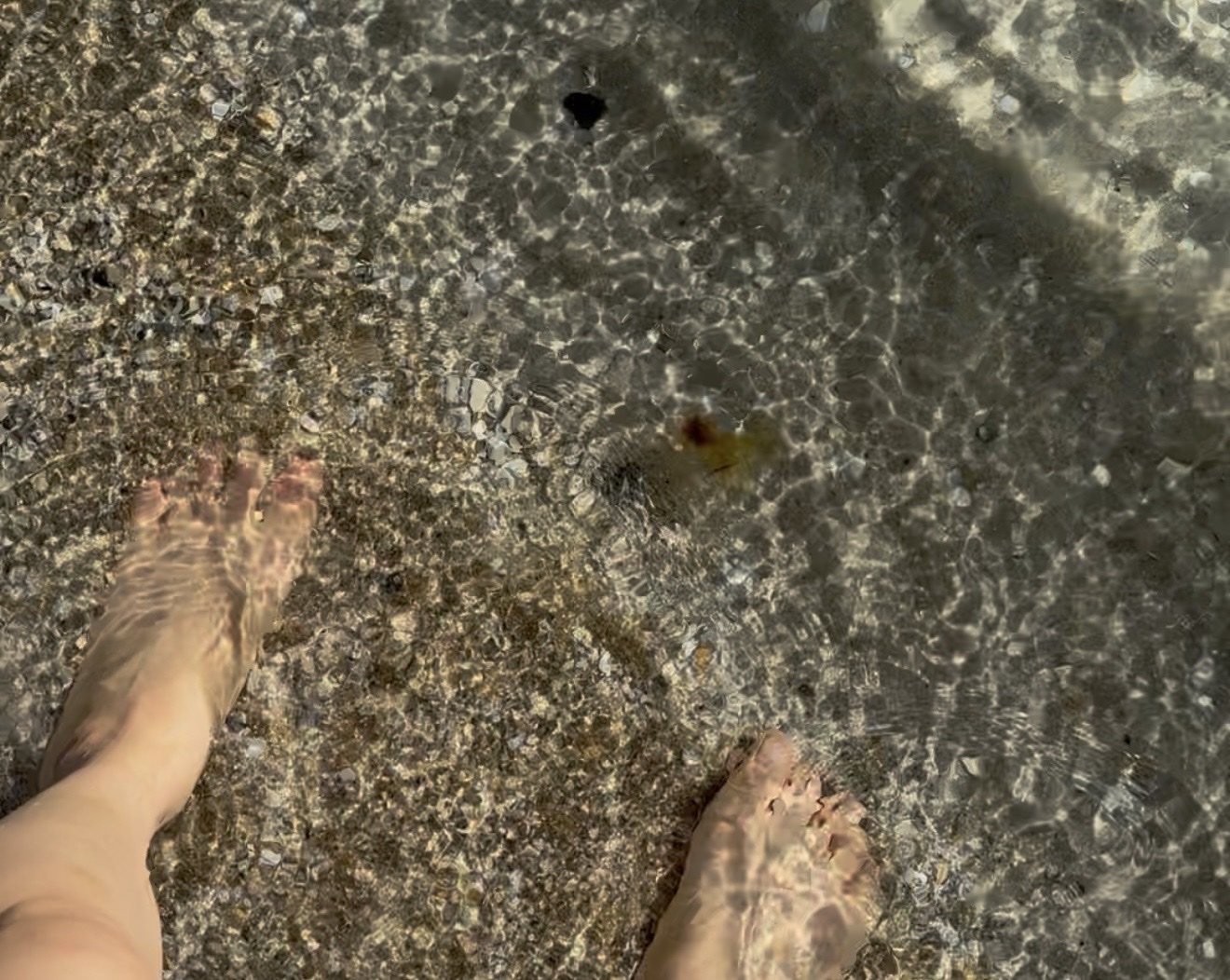
When Did We Stop Touching the Earth?
Earthing: Reconnecting with Nature Through Our Bare Feet
When was the last time you walked barefoot on grass, soil, or sand?
Modern life keeps us surprisingly disconnected from the ground. We walk on indoor floors, wear shoes outside, travel by car, and move from one building to another.
Then we take our shoes off.
Cool grass beneath the feet.
The texture of soil.
Sand moving between the toes.
Such a simple experience can feel surprisingly calming.
This direct contact with the Earth's surface is known as Earthing or Grounding.
But could there be more to it than simply feeling good?
What Is Earthing?
Earthing is simple: placing bare skin, usually the feet, directly on natural surfaces such as grass, soil, or sand.
The Earth's surface is electrically conductive, and so is the human body. When we make conductive contact with the ground, electrical charge can move between the body and the Earth, bringing the body's electrical potential closer to that of the ground.
Researchers have been exploring whether this physical phenomenon might also influence human physiology.
Where Did the Idea of Earthing Come From?
The concept of Earthing, also known as Grounding, gained wider attention through a 2012 paper by Chevalier, cardiologist Stephen Sinatra, Oschman and colleagues.
The theory behind Earthing begins with the electrical properties of the Earth.
The Earth's surface has a supply of free or mobile electrons. Earthing researchers have proposed that when the body makes direct conductive contact with the ground, electrons can move between the Earth and the body, bringing the body's electrical potential closer to that of the ground.
So Earthing is not simply about walking barefoot.
The central idea is the contact itself : reconnecting the body electrically with the ground beneath us.
Earthing, Inflammation and Recovery
One area of interest is inflammation.
Inflammatory responses involve immune activity and reactive oxygen species (ROS). Earthing researchers have proposed that electrons exchanged through contact with the Earth's surface may influence oxidative and inflammatory processes.
A 2015 paper in the Journal of Inflammation Research explored possible relationships between grounding, inflammation, immune responses, exercise recovery, and wound healing.
The possibility of the electrical contact with the Earth may influence physiological process is the main questions of this research and emerging researches are showing sceintific interest of this methods.
Earthing, Sleep and Stress
Sleep and stress have also been studied.
In a small 2004 pilot study, 12 people reporting sleep disturbance, pain, and stress were grounded during sleep. Researchers observed changes in night-time cortisol and circadian cortisol patterns, while participants also reported improvements in sleep, pain, and stress.
What About the Autonomic Nervous System?
Small experimental studies have also reported changes in measures such as skin conductance, respiration, pulse, and heart rate variability (HRV), prompting interest in possible effects on autonomic regulation.
But walking barefoot in nature involves more than electrical grounding.
We feel different textures through our feet.
We slow down.
Our movement changes.
We notice our breathing and the environment around us.
Perhaps part of the Earthing experience comes from this combination of ground contact, sensory input, movement, and nature.
Do You Get Static Shocks All the Time?
Some people seem to experience static electricity everywhere, touching a car door, taking off clothing, or even touching another person.
This is particularly common in dry weather.
We sometimes describe someone as being "prone to static electricity," although modern medicine does not recognise a particular body constitution that causes it.
Static electricity occurs when electrical charge accumulates on the body, often through friction while the body is insulated from the ground. Touching a conductive object such as metal can then cause the accumulated charge to discharge rapidl, the familiar little "zap."
This is where grounding makes straightforward physical sense.
When the body is connected to the Earth through a conductive pathway, accumulated charge can dissipate and the body's electrical potential can move closer to that of the ground.
The same basic principle is used in the electronics industry, where workers are grounded to prevent static charge from damaging sensitive components.
If you frequently experience static shocks, try standing or walking barefoot for a little while on safe grass or sand.
Think of it simply as reconnecting your body with the ground.
The Feet and the Earth in East Asian Medicine
There is an interesting parallel in traditional East Asian medicine.
Several meridians travel through the feet, and on the sole lies Yongquan (湧泉, KI1), the first point of the Kidney meridian.
Its name has a beautiful meaning:
湧 — to well up
泉 — spring
Together, Yongquan evokes the image of "a spring welling up from the earth."
Traditionally, the point has been used to draw excessive upward activity downward and to connect the upper and lower aspects of the body.
The body does not exist entirely separately from the world around it.
Earthing Doesn't Need to Be Complicated
Try it on the grass in your local park, in the garden, or on the sand at the beach.
Take off your shoes and begin with 10–20 minutes of gentle walking.
There is no need to turn it into another workout.
Instead, notice the ground.
Is it cool or warm?
Soft or rough?
How do your toes respond?
How does your walking change?
On sand, the constantly changing surface also asks the feet and ankles to make small adjustments with every step.
Perhaps Earthing is less about how far we walk and more about how much we feel.
A Note on Barefoot Safety
Barefoot walking should always begin with one principle:
Keep your feet safe.
If you have reduced foot sensation, diabetic peripheral neuropathy, wounds or infection, poor peripheral circulation, or an increased risk of falling, speak with a healthcare professional before walking barefoot.
Avoid sharp objects and extremely hot or cold surfaces, and start gradually.
Feel the Ground Again
The next time you find yourself on a safe grassy area or at the beach, take your shoes off for a moment.
Feel the temperature and texture beneath your feet. Walk a little more slowly. Notice sensations that normally disappear inside your shoes.
Reconnecting with nature does not have to be complicated.
Take off your shoes.
Place your feet on the ground.
And simply notice what you feel.
Earthing can begin right there.
References
Ghaly M, Teplitz D. The biologic effects of grounding the human body during sleep as measured by cortisol levels and subjective reporting of sleep, pain, and stress. Journal of Alternative and Complementary Medicine. 2004;10(5):767–776.
Chevalier G, Sinatra ST, Oschman JL, Sokal K, Sokal P. Earthing: Health implications of reconnecting the human body to the Earth's surface electrons. Journal of Environmental and Public Health. 2012;2012:291541.
Oschman JL, Chevalier G, Brown R. The effects of grounding (earthing) on inflammation, the immune response, wound healing, and prevention and treatment of chronic inflammatory and autoimmune diseases. Journal of Inflammation Research. 2015;8:83–96.
#Earthing #Grounding #BarefootWalking #NatureAndHealth #StaticShock #Acupuncture #AutonomicNervousSystem #MelbourneChineseMedicine