# When Fear Has Nowhere to Run
From the Psoas to the Piriformis: Emotion, Trauma and the Body’s Protective Response
Think about what happens when something suddenly frightens you.
Before you even have time to think, your heart begins to race.
Your breathing changes.
Your shoulders and abdomen tighten.
Some people freeze, while others feel their legs go weak beneath them.
There is a reason we use expressions such as “I froze with fear” or “my chest felt tight.”
Fear is an emotion we experience in the mind, but the body experiences it too.
These days, we often hear the phrase “trauma is stored in the body.”
But are emotions or traumatic memories really stored inside particular muscles?
I prefer to ask the question a little differently:
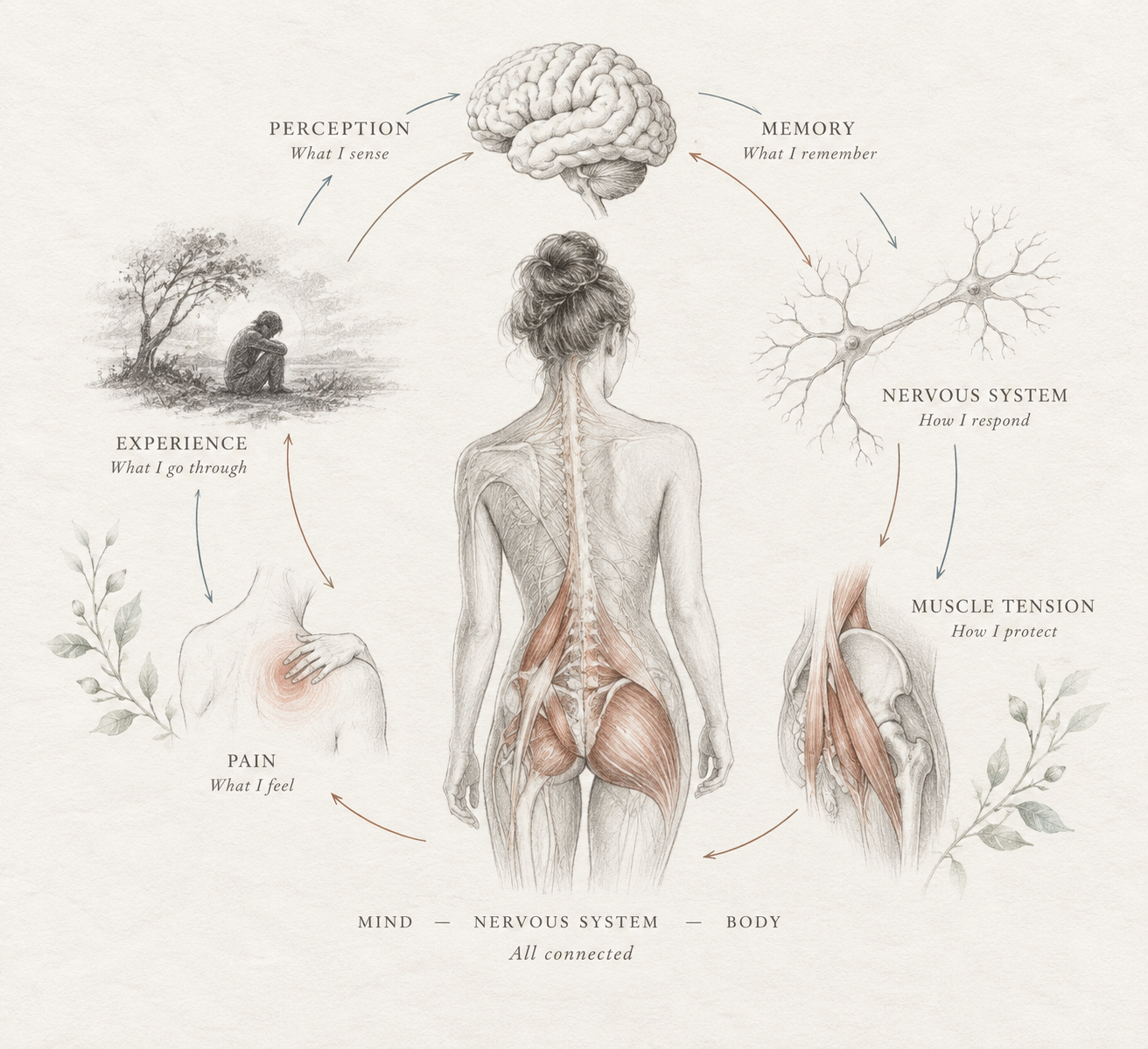
If the danger has already passed, but the nervous system still senses danger, how long might the body continue to hold itself in a state of tension?
The Psoas: A Muscle Ready to Run
The psoas lies deep within the body, beginning in the lower spine, passing through the pelvis and connecting to the femur. It plays an important role in walking, running, lifting the leg and stabilising the body.
In somatic therapy and wellness circles, the psoas is sometimes described as the “muscle of fear.”
Scientifically, however, there is not sufficient evidence to say that fear itself is literally “stored” in the psoas.
What is more interesting is what happens throughout the body when we perceive danger.
When we become frightened, the body rapidly prepares for survival. Heart rate increases, breathing changes and muscles become more activated. We may prepare to fight, run away or, at times, become still as part of a protective response.
Normally, once the danger has passed, these responses gradually settle.
But what happens when the event is over, yet the body does not fully let go of its state of tension?
When the Event Is Over but the Body Remains on Alert
This is an important part of understanding trauma and post-traumatic stress disorder (PTSD).
Trauma is not simply about being unable to forget a frightening memory. Sounds, smells, places, movements and sometimes even subtle physical sensations associated with a previous threat can continue to provoke heightened nervous-system responses.
Put simply,
the event may be over, but the body may continue to say, “I still need to be careful.”
Muscles may also continue to participate in this protective state.
One way to think about this is that the body may continue trying to protect us for longer than it needs to.
Could Piriformis Pain Be Part of This Picture?
In clinical practice, I sometimes see people with persistent pain deep in the buttock.
“I’ve tried all sorts of treatments, but it still hurts.”
“If I sit for too long, I get this deep discomfort in my buttock.”
“It’s not quite my back and not quite my leg. It just feels painful somewhere deep inside.”
The piriformis is a small muscle deep within the pelvis that connects the sacrum to the femur. The sciatic nerve runs close to this region, which is one reason problems involving this area may be associated with symptoms in the buttock and sometimes further down the leg.
This does not mean that stress or trauma directly causes piriformis pain.
But the muscles around the pelvis do not function in isolation from the rest of the body.
When we anticipate pain or remain in a heightened state of vigilance, the way we move and recruit our muscles can change. Research in women with PTSD symptoms has also reported increased pelvic floor muscle activity, with associations particularly observed in relation to hyperarousal symptoms.
So rather than saying,
“Fear is stored in the pelvis or piriformis,”
it may be more accurate to say:
“The nervous system’s protective responses can continue to influence muscular tension and the way we move.”
More Than 2,000 Years Ago, Medicine Was Already Talking About Fear That Does Not Resolve
This brings to mind an ancient passage from East Asian medicine.
In the Lingshu Benshen (靈樞·本神), part of the Huangdi Neijing (Yellow Emperor’s Inner Classic), we find the phrase:
恐懼而不解則傷精
It can be understood as:
“When fear and fright remain unresolved, they may injure Jing (Essence).”
What I find particularly interesting is the expression 不解 (bu jie) — “not resolving” or “not being released.”
The emphasis is not simply on experiencing fear, but on fear that remains unresolved.
Of course, concepts from medicine more than two thousand years ago should not be treated as equivalent to modern PTSD or contemporary neurophysiology.
But placing these two perspectives alongside each other raises an interesting question.
Modern medicine might ask:
“If the danger has passed but the nervous system continues to perceive threat, what changes might persist in the body?”
Ancient East Asian medicine observed:
恐懼而不解 — when fear does not resolve.
The language, concepts and medical frameworks are very different. Yet it is fascinating that people have long wondered about how unresolved fear may affect the body.
When We Treat Pain, Should We Look Only at the Muscle?
When we experience persistent muscular pain, it is natural to ask:
“Which muscle is tight?”
“Where do I need to release the tension?”
These are important questions.
But sometimes there is another question worth asking:
“Why does this body still feel that it needs to hold on so tightly?”
Persistent pain cannot always be explained by a single muscle.
The nervous system, sleep, stress, previous experiences of pain, fear of movement and other physical factors can interact with one another.
For this reason, recovery may sometimes need to be viewed more broadly than simply trying to “release” a tight muscle.
Sleeping well.
Breathing comfortably.
Moving in ways that feel safe.
Gradually rebuilding trust in the body.
Perhaps what a body that has been tense for a long time needs to rediscover is the feeling:
“It is safe to soften a little now.”
The process of finding that feeling again may itself be one part of recovering from persistent pain.
Tags
#MelbourneChineseMedicine #PersistentPain #Psoas #Piriformis #TraumaAndTheBody #NervousSystem #EastAsianMedicine