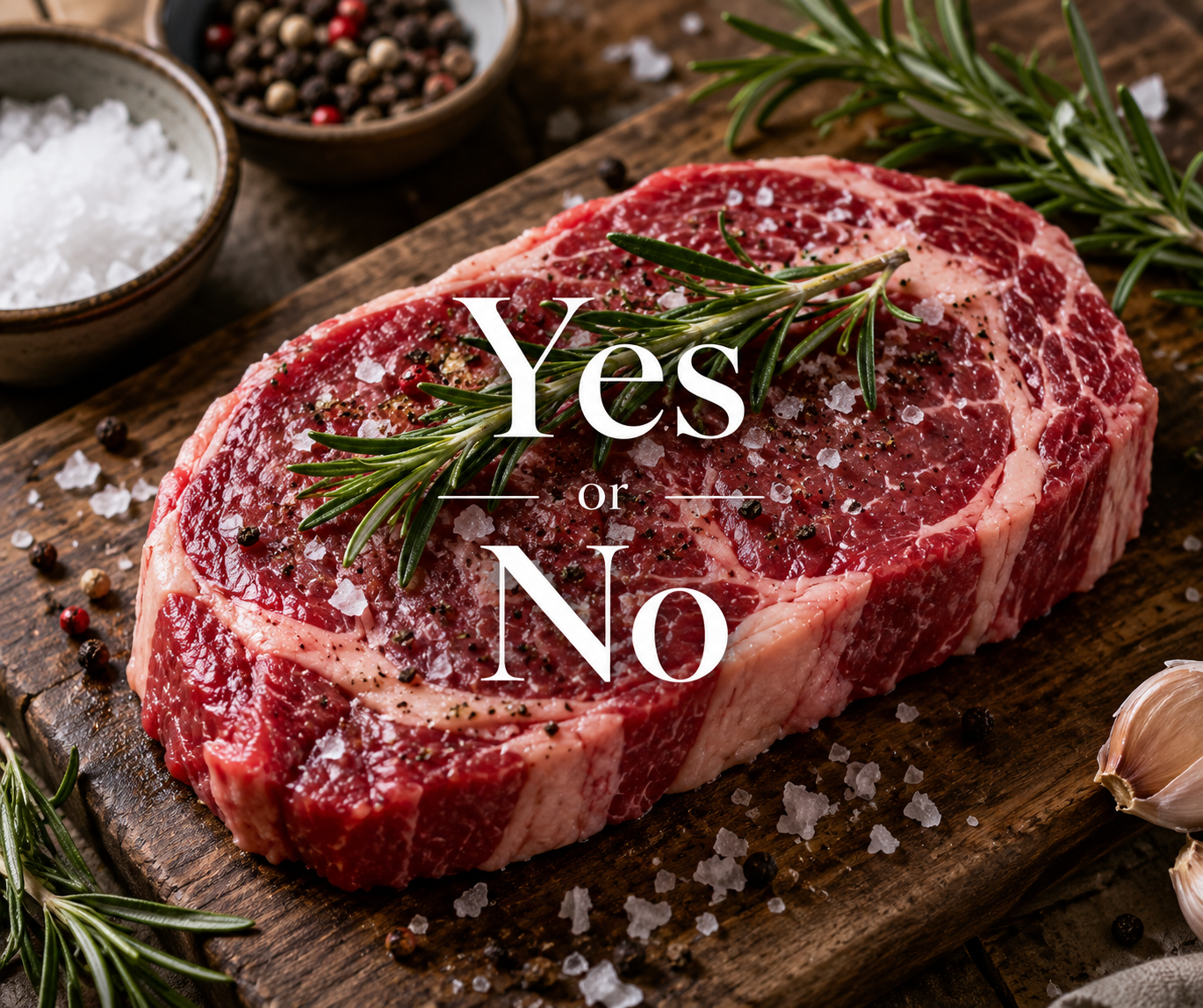
When it comes to health and nutrition, we are often presented with seemingly contradictory advice.
“Red meat is rich in iron and protein, so we should eat it.”
Then, from the other side:
“Red meat may increase the risk of cancer, so we should limit it.”
So, who is right?
Perhaps we need to begin with a different question.
Instead of asking:
“Is red meat good or bad?”
perhaps we should ask:
“Who is eating it, in what condition, how much, and in what form?”
That simple shift in perspective can change the way we think about food entirely.
Is Red Meat Really Bad for Us?
When we look at the scientific evidence, the answer is more nuanced than it may first appear.
Red meats such as beef, pork, and lamb provide high-quality protein as well as important micronutrients including iron, zinc, and vitamin B12. There is also no general recommendation that people undergoing cancer treatment must completely avoid meat.
For some people undergoing treatment—particularly those experiencing reduced appetite, weight loss, or difficulty maintaining muscle mass—meeting adequate energy and protein requirements may become an important nutritional priority.
Recent dietary guidance also does not treat unprocessed red meat as a food that everyone must categorically avoid. The 2025–2030 Dietary Guidelines for Americans, for example, place greater emphasis on nutrient-dense, minimally processed foods and include animal sources of protein within a healthy dietary pattern.
However, not every health organisation interprets the evidence in exactly the same way.
Cancer-prevention recommendations continue to advise limiting red and processed meat, while concerns have also been raised within cardiovascular nutrition about dietary patterns high in certain animal foods.
So what should we believe?
Perhaps the confusion itself reveals something about the way we have learned to think about nutrition.
We want foods to belong to one of two categories:
Good or bad.
Healthy or unhealthy.
Eat or avoid.
But nutrition is rarely that simple.
The World Cancer Research Fund (WCRF), for example, currently recommends that people who consume red meat limit it to approximately 350–500 g cooked weight per week, while consuming very little, if any, processed meat such as bacon, ham, salami, and some sausages. This recommendation reflects evidence linking red and, particularly, processed meat consumption with colorectal cancer.
So the current evidence does not simply tell us:
“Eat meat.”
Nor does it simply say:
“Never eat meat.”
There is a considerable space between these two positions.
Why Is Red Meat a Concern in the First Place?
One important area of scientific discussion involves haem iron, the iron-containing compound that contributes to the characteristic colour of red meat.
The International Agency for Research on Cancer (IARC) has examined several potential mechanisms associated with red and processed meat consumption, including haem iron and the formation of N-nitroso compounds.
Cooking method matters as well.
Cooking meat at high temperatures—particularly pan-frying, grilling, or barbecuing—can generate compounds including heterocyclic aromatic amines (HCAs) and polycyclic aromatic hydrocarbons (PAHs).
This brings us to another interesting question:
Does soaking meat and removing its red juices eliminate these risks?
Based on the evidence currently available, we cannot confidently make that claim.
Traditional methods of soaking or preparing meat may have culinary value, but there is currently insufficient clinical evidence to conclude that removing the liquid from raw meat meaningfully reduces the cancer risk associated with red-meat consumption.
For this reason, I would regard such practices as traditional or culinary approaches rather than presenting them as scientifically established methods of cancer prevention.
But Is the Same Diet Right for Everyone?
This is where the question becomes more interesting to me.
Two people can eat exactly the same meal and experience it very differently.
One person may digest meat comfortably and feel satisfied for hours, while another may experience heaviness, bloating, or discomfort.
Some people feel at their best eating predominantly plant-based meals. Others may find it more difficult to meet their individual energy or nutritional requirements in the same way.
We differ in age.
We differ in digestive capacity.
We differ in physical activity.
We differ in health and treatment status.
And our nutritional and energy requirements differ.
So why would we expect exactly the same diet to be appropriate for everyone?
This Is Where East Asian Medicine Considers Constitution
Traditionally, East Asian medicine has not understood food solely in terms of grams of carbohydrate, protein, and fat.
It has also considered the characteristics of the individual: digestion and assimilation, patterns of heat and cold, activity and recovery, environment, season, and the person's broader physical and psychological tendencies.
One framework developed to understand these individual differences is the concept of body constitution (體質).
But there is an important caveat.
Assessing constitution is more complicated than it appears.
Answering a few questions online and concluding:
“I am a Soyang type.”
“I have a cold constitution.”
“I am a Wood type.”
may be appealing, but it does not capture the complexity of constitutional assessment.
Even within Traditional East Asian Medicine, there is no single universal system of constitution.
Chinese body constitution theory, Korean Sasang Constitutional Medicine and Eight Constitution Medicine, as well as various Japanese traditional approaches, have developed from different theoretical foundations and use different methods of assessment.
More importantly, we need to distinguish between constitution and current state.
Someone who normally has a strong appetite and good digestion may experience something very different following surgery or during cancer treatment.
A person who is naturally energetic and active may find their capacity for recovery dramatically altered by illness, prolonged stress, or insufficient sleep.
For this reason, constitution may be more useful when it is understood not as a permanent label attached to a person, but as one perspective from which to ask:
“What tendencies does this person generally have, and how has their present state shifted away from their usual balance?”
Perhaps the Person Matters More Than the Food
The debate surrounding red meat illustrates this beautifully.
We repeatedly ask food itself to give us the answer.
Is meat good?
Are beans better?
Is coffee healthy?
Are cold foods bad for us?
But a food in isolation rarely gives us the complete picture.
Consider two people.
One is undergoing cancer treatment and experiencing significant loss of weight and muscle mass.
The other is healthy and considering their long-term dietary pattern in relation to colorectal cancer prevention.
It would be difficult to assume that their nutritional priorities should be identical.
Even the WCRF acknowledges that red meat can provide valuable nutrients, including protein, iron, zinc, and vitamin B12, while noting that people who choose not to eat it can obtain these nutrients from other appropriately selected foods.
The question therefore needs to become more specific:
What does this person need right now?
Finding that answer requires us to look beyond a single food.
We need to consider the overall dietary pattern, nutritional status, illness and treatment, digestive capacity, lifestyle, and individual characteristics.
Knowing Your Constitution Is Not About Receiving a List of Foods You Can and Cannot Eat
For me, this is one of the most interesting aspects of constitutional medicine.
Understanding constitution should not simply mean being handed a list that says:
“You are this type, therefore you should eat beef and avoid these foods.”
It can instead encourage more meaningful questions:
Under what circumstances do I tend to lose my balance?
Which foods do I digest comfortably?
What kinds of lifestyle patterns leave me depleted?
How much activity can I sustain, and how much recovery do I need?
How is my body today different from how it usually feels?
Understanding these patterns is far more complex than assigning ourselves a simple constitutional label.
And when someone is living with a medical condition or undergoing treatment, this becomes even more important. Rather than substantially restricting or increasing particular foods on the basis of self-diagnosis alone, dietary decisions should be considered alongside appropriate advice from the treating healthcare team, an accredited dietitian, or another suitably qualified health professional.
So, Should I Eat Red Meat?
My answer would be:
“First, we need to look at you.”
What we eat certainly matters.
But so does who is eating it.
How much.
How often.
How it is prepared.
What our current state of health is.
And where that food sits within the context of our overall diet.
Health is far more complex than dividing individual foods into categories of “good” and “bad.”
Perhaps understanding our constitution begins with respecting precisely that complexity.